
BRICS 2026 latest update: New Delhi summit
India hosted the 18th BRICS Summit at Bharat Mandapam on 12–13 September 2026. Leaders unanimously adopted the New Delhi Declaration. This page states what was agreed, what Modi, Xi, and Putin said in bilateral meetings, and what is still unresolved as of 13 September 2026.
AshnaAI
What happened at the 18th BRICS Summit in New Delhi?
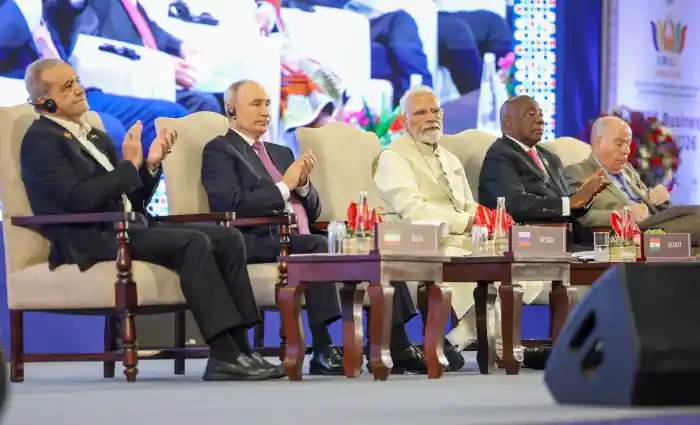
India hosted the 18th BRICS Summit at Bharat Mandapam on 12 and 13 September 2026. The chairship theme is “Building for Resilience, Innovation, Cooperation and Sustainability.” The grouping marks twenty years since the first BRIC foreign ministers' meeting in 2006. Official context lives on brics2026.gov.in.
On Saturday 12 September, Prime Minister Narendra Modi announced that the New Delhi Declaration 2026 had been adopted unanimously. Hindustan Times quoted him: “No member has raised any objection.” The same report said officials negotiated through the night, until about 4 a.m., because several files were contested. India Today treated first-day adoption as a diplomatic win for the chair.
The political theatre was India–China–Russia. AFP described Xi, Putin, and Iran's Masoud Pezeshkian arriving as wars, trade, and energy tested the 11-member table. Modi's opening line, in that report, was that a “pyramid of privilege” had to become a “platform of partnership.” This page is a news brief. The longer “why the bloc exists” note is Why BRICS matters in 2026.
What the New Delhi Declaration actually adopted
The circulated English text — posted among other places as a Kremlin-hosted PDF — opens by restating the BRICS spirit of sovereign equality, consensus, and three pillars: political and security, economic and financial, and people-to-people. It commends India for more than four hundred meetings across thirty Indian cities during the chairship, and for the BRICS Plus / Outreach segment.
On global governance, paragraph 13 repeats support for comprehensive UN reform, including the Security Council, and for a larger voice for Africa, Asia, and Latin America. China and Russia “reiterate their support to the aspirations of Brazil and India to play a greater role in the UN, including its Security Council.” Paragraphs 17–20 push IMF quota realignment, World Bank shareholding, and restoration of a two-tier WTO dispute-settlement system. Ethiopia and Iran's WTO accession bids are named. Unilateral tariffs and coercive measures are condemned.
On peace and security, the text expresses concern over West Asia escalation, calls for protection of civilians and shipping, and records “serious concern” over attacks on civilian infrastructure and IAEA-safeguarded peaceful nuclear facilities. It condemns terrorism “whenever, wherever and by whomsoever committed,” and specifically condemns the 22 April 2025 terrorist attack in Jammu and Kashmir that killed 26 people. Gaza, Lebanon, Sudan, and Syria each have their own careful paragraphs. Ukraine is not written as a named war file in the same way; readers should not invent a line that is not there.
| File | What the text does | What it does not do |
|---|---|---|
| UN Security Council | Supports comprehensive reform; China and Russia restate support for Brazil and India | Does not name new permanent members or a voting timetable |
| IMF and World Bank | Pushes quota and shareholding realignment for emerging economies | Does not announce a new BRICS reserve currency |
| WTO and tariffs | Wants the Appellate Body restored; condemns unilateral tariffs and coercive measures | Does not create a BRICS customs union |
| West Asia | Calls for restraint, civilian protection, shipping safety, and concern over attacks on nuclear sites | Does not issue a single named verdict on every party to the 2026 war |
| Terrorism | Condemns all terrorism and names the 22 April 2025 Jammu and Kashmir attack | Does not itself designate new entities beyond existing UN lists |
| AI and digital | Commits to the BRICS AI governance statement, DPI repository, sovereign digital ecosystems | Does not publish a binding BRICS AI law |
What Modi, Xi, and Putin discussed on the margins
Russian President Vladimir Putin was the first leader to arrive. The Hindu reported that the 11 September bilateral discussed raising India–Russia trade toward $100 billion by 2030, civil nuclear cooperation, critical minerals, railways, tunnelling, and steel. India's Ministry of External Affairs, as carried by DW, said the two sides also discussed West Asia and the Black Sea region because those conflicts have hit maritime trade and the safety of Indian seafarers. They restated the Special and Privileged Strategic Partnership. Putin last visited India in December 2025.
Chinese President Xi Jinping arrived on 12 September — his first visit to India since 2019, and the most watched thaw step since the 2020 Galwan clash. CNBC quoted Modi saying “peace and tranquillity” in the border areas is essential for the relationship. Both governments said they would seek a “fair, reasonable, and mutually acceptable” boundary settlement. Hindu Business Line added the economic core: structural trade imbalance, supply-chain friction, and predictable market access, including Indian concern over Chinese export curbs on rare earths and critical machinery. Direct flights and some old trade routes have already resumed; this meeting was about whether that thaw holds.
Iranian President Masoud Pezeshkian was also in the city. His presence, and the West Asia war that began with US–Israeli strikes on 28 February 2026, is why energy and shipping sit next to UN reform in every summit preview. India has partly covered the energy shock by buying more from Russia. That fact is in the AFP and Al Jazeera previews. It is not a BRICS decision. It is the backdrop the chair had to manage.
What Russia, China, and Iran in one capital means
Putin, Xi, and Pezeshkian were the three arrivals the wires treated as the political test of India's chair. AFP framed the weekend as those leaders gathering while wars, trade, and energy tested the 11-member table. That is presence and optics. It is not a published Russia–China–Iran treaty, and it is not a BRICS military pact.
What it does mean — energy cover, sanctions-resistant payments talk, a West Asia file that almost blocked the May foreign-ministers' statement, and India's job of seating Iran next to the UAE and Saudi Arabia — is in What Russia, China, and Iran mean at BRICS 2026.
What is still unresolved as of 13 September 2026
A unanimous declaration is not the same as a settled war. The West Asia paragraphs are restraint language, not a ceasefire mechanism. Foreign ministers could not agree a joint statement in May; leaders papered the gap in September with words every capital could live with. Treat that as success for the chair and as unfinished business for the region.
India–China: the bilateral restated process. It did not announce a final LAC settlement or a closed trade package. Eight points from the 25th round of talks last month are the working track. Rare-earth and market-access complaints remain live.
Finance files — local-currency payments, a grain exchange, a New Investment Platform, BRICS Multilateral Guarantees — are still “continue the work” items in the declaration. Do not report them as launched products. Day-2 outreach and any unpublished bilateral MoUs after this page's timestamp should be checked against the Ministry of External Affairs and the chairship site, not inferred.
AI, digital public infrastructure, and the rest of the tech agenda
The technology chapter is large enough to stand alone. The Hindu and Rediff both led on wider access to AI resources, a sovereign digital ecosystem, a digital public infrastructure repository, cybersecurity, quantum, startups, and a possible high-speed submarine cable study among BRICS countries. The dedicated explainer is BRICS AI policy and global AI governance.
Brief the summit from the source documents
People compiling a one-pager or deck from the New Delhi Declaration use How to generate a PowerPoint. People grounding a chat in the PDF use How to chat with a PDF. New accounts start at app.ashna.ai/signup.
Frequently asked questions
- What is the latest update on the BRICS 2026 summit?
- India hosted the 18th BRICS Summit in New Delhi on 12–13 September 2026. On 12 September Prime Minister Narendra Modi announced that the New Delhi Declaration 2026 had been adopted unanimously. The text covers UN and IMF reform, West Asia, trade, terrorism, digital public infrastructure, and AI governance. Bilateral meetings with Vladimir Putin (11 September) and Xi Jinping (12 September) ran alongside the plenary.
- Where was the 18th BRICS Summit held?
- At Bharat Mandapam, Pragati Maidan, New Delhi, on 12 and 13 September 2026. Putin arrived on 11 September and visited the INNOPROM exhibition with Modi before the formal summit opened.
- What does the New Delhi Declaration 2026 say?
- It is a consensus leaders' statement under the theme “Building for Resilience, Innovation, Cooperation and Sustainability.” Headline items include comprehensive UN Security Council reform, IMF and World Bank shareholding reform, restoration of WTO dispute settlement, concern over unilateral tariffs, a West Asia restraint paragraph, condemnation of the 22 April 2025 Pahalgam-area attack in Jammu and Kashmir, and a commitment to implement the BRICS AI governance statement.
- Did Modi, Xi, and Putin meet in New Delhi?
- Yes. Putin held a bilateral with Modi on 11 September. Xi held a bilateral with Modi on 12 September, his first visit to India since 2019. All three sat in the BRICS plenary. Those bilaterals are national diplomacy hosted on the summit's margins, not extra BRICS treaties.
- Did every BRICS member agree?
- On the declaration, Modi said no member raised an objection. That matters because BRICS is consensus-based: one holdout can block a text. Foreign ministers had failed to agree a joint statement in May 2026. The September text still uses careful phrasing on West Asia and does not name every party to every war.
Tags
Related
Try this in AshnaAI. Create a free account.
Found this article helpful? Share it with your network.