
Why BRICS matters in 2026
BRICS is no longer a four-letter market acronym. In 2026 the 11-member grouping holds about half the world's people and, on purchasing-power terms, more output than the G7. Here is why the bloc matters for trade, finance, UN reform, and the Global South — and why India, China, and Russia sit at the centre of the story.
AshnaAI
What is BRICS in 2026?
BRICS began as a market shorthand. Goldman Sachs economist Jim O'Neill coined BRIC in 2001. The diplomatic grouping is younger: BRIC foreign ministers first met on the UNGA sidelines in New York in 2006, and the first summit was in Yekaterinburg in 2009. South Africa joined in 2011. That history is on India's official BRICS 2026 site.
In 2026 the chairship lists eleven members: Brazil, China, Egypt, Ethiopia, India, Indonesia, Iran, Russia, Saudi Arabia, South Africa, and the United Arab Emirates. Egypt, Ethiopia, Iran, Saudi Arabia, and the UAE became full members from January 2024. Indonesia joined in January 2025. Ten partner countries — Belarus, Bolivia, Kazakhstan, Cuba, Malaysia, Nigeria, Thailand, Uganda, Uzbekistan, and Vietnam — joined in 2025. Partners attend some meetings; they do not automatically sign the leaders' declaration.
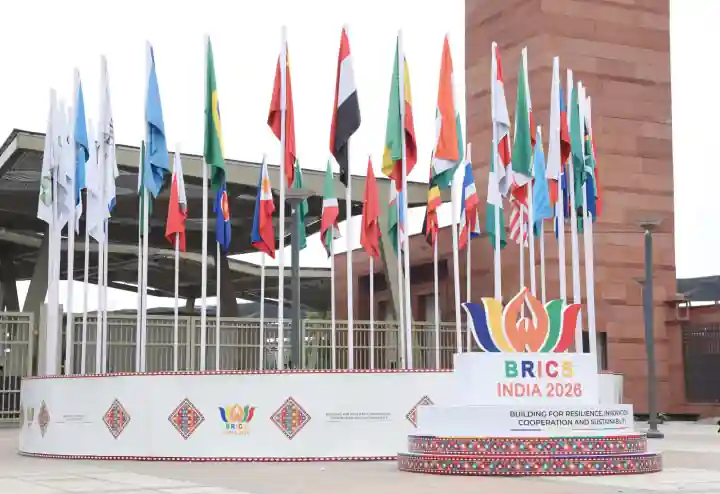
The 18th summit met in New Delhi on 12–13 September 2026 under the theme “Building for Resilience, Innovation, Cooperation and Sustainability.” That is India's year as chair, twenty years after the first BRIC ministers' meeting. The latest outcomes are in BRICS 2026 latest update.
Why BRICS matters for the world economy
Scale is the first reason the grouping is hard to ignore. The chairship site states that BRICS accounts for 49.5% of world population, about 40% of world GDP, and 26% of world trade. India Today, citing IMF purchasing-power figures for 2025, put the 11 members at 40.5% of world output versus 28.3% for the G7. The same piece says the eleven, held fixed, rose from 26% of world output in 2005 to 40.5% in 2025.
Those two ways of counting must stay separate. Purchasing-power parity asks what an economy actually produces at local prices. On that measure BRICS is now the larger bloc. On market-exchange-rate dollars, India Today put the share near 27.9%. China alone is about 59.5% of the bloc's dollar output, so a sentence about “BRICS rising” is still, in large part, a sentence about China rising. India's own PPP share, in that report, doubled from 4% in 2001 to 8.2% in 2025.
The second reason is institutional. The New Development Bank, created by the original five in 2015 and based in Shanghai, is the grouping's main financial instrument. The NDB homepage lists $42.9 billion approved across 139 projects. In June 2026 remarks, NDB vice-president Roman Serov said approvals had reached $44 billion across 141 projects by 30 June, with about $25 billion disbursed and local-currency operations near 30%. NDB membership is not identical to BRICS membership: Bangladesh, Algeria, and others sit at the bank without being BRICS leaders' table members.
| Measure | Figure | Source and caveat |
|---|---|---|
| Members | 11 listed by the chair | Saudi Arabia is listed; some reporting says Riyadh has not publicly confirmed |
| Partner countries | 10 from 2025 | Attend some meetings; do not automatically sign declarations |
| World population | 49.5% | Official BRICS 2026 chairship site |
| World GDP (chairship) | About 40% | Official site; method not specified on the landing page |
| World output, PPP, 2025 | 40.5% vs G7 28.3% | India Today, citing IMF |
| World GDP, dollars, 2025 | About 27.9% | India Today; falls to 26.8% if Saudi Arabia is excluded |
| World trade | 26% | Official chairship site |
| NDB approvals | $42.9bn / 139 projects | NDB site; $44bn / 141 projects by 30 June 2026 per Serov |
Why India, China, and Russia sit at the centre
The 18th summit's media gravity ran through three capitals even though eleven flags were in the room. AFP and Al Jazeera framed the week around Xi Jinping's first visit to India since 2019, Vladimir Putin's arrival on 11 September, and Narendra Modi's role as chair. That is not a claim that other members do not matter. It is a claim about who can move markets, energy flows, and the UN Security Council conversation in the same week.
China is the economic heavyweight. Any BRICS finance, manufacturing, or AI sentence that ignores Beijing is incomplete. Russia remains one of India's most important strategic partners: The Hindu reported that the 11 September bilateral discussed a $100 billion trade target by 2030, civil nuclear projects, critical minerals, railways, and steel. India has also bought Russian energy while navigating the West Asia shock.
India is the chair and the swing. It wants a louder Global South voice without becoming a China-led caucus. The Modi–Xi bilateral on 12 September put border peace and the trade imbalance on the table — CNBC and Hindu Business Line both led on “peace and tranquillity” along the Line of Actual Control and on structural trade concerns, including rare-earth and machinery supply. That thaw is cautious. It is also why this summit looked different from a routine rotating meeting.
Why BRICS matters for global rules, not only for GDP
The New Delhi Declaration, adopted unanimously on 12 September 2026, is a consensus document. Any one member can block it. That is why the text is long and why the overnight negotiation, reported by Hindustan Times, ran until 4 a.m. The political payload is reform, not rupture: a more representative UN Security Council, IMF quota realignment, WTO dispute-settlement restoration, and opposition to unilateral tariffs and coercive measures.
China and Russia, as permanent Security Council members, restated support for Brazil and India to play a greater role in the UN, including the Council. African representation is tied to the Ezulwini Consensus and the Sirte Declaration. That language is recycled from Johannesburg 2023 and Beijing 2022. Recycled does not mean empty: it is the bloc's standing bid to rewrite who sits at the table.
Technology is now in the same folder as finance. Paragraph 81 of the declaration commits members to implement the BRICS Leaders' Statement on the Global Governance of Artificial Intelligence, congratulates India on the February 2026 AI Impact Summit, and calls for wider access to AI resources for the Global South. That track is unpacked in BRICS AI policy and global AI governance.
What BRICS is not
It is not a military alliance. It is not NATO's opposite number. Members disagree on West Asia, on Ukraine, and often on how far to go in naming the United States. Foreign ministers failed to agree a joint statement in New Delhi in May 2026, AFP reported, because Iran, Saudi Arabia, and the UAE were split over the war that began with US–Israeli strikes on 28 February. Leaders still produced a declaration in September. That is the grouping's real skill: lowest-common-denominator consensus under pressure.
It is not a single market or a single currency. Local-currency settlement, the BRICS Payment Task Force, and a possible grain exchange appear in the declaration as work in progress, “no one-size-fits-all.” Treat those lines as mandates for officials, not as a live BRICS dollar replacement.
It is not costless for India. Hosting China and Russia in the same week, while remaining a Quad partner and a large US technology and defence customer, is a balancing act. The point of the chairship is to show that New Delhi can hold that tension and still extract a unanimous text. What Putin, Xi, and Pezeshkian in one capital signals — and what it is not — is in What Russia, China, and Iran mean at BRICS 2026.
Brief the summit from the source documents
People compiling a one-pager or deck from the New Delhi Declaration use How to generate a PowerPoint. People grounding a chat in the PDF use How to chat with a PDF. New accounts start at app.ashna.ai/signup.
Frequently asked questions
- What is BRICS in 2026?
- BRICS is a consultation and cooperation grouping of major emerging markets. India's 2026 chairship lists 11 members: Brazil, China, Egypt, Ethiopia, India, Indonesia, Iran, Russia, Saudi Arabia, South Africa, and the UAE. Ten partner countries joined in 2025. It is not a military alliance and not a customs union.
- Why does BRICS matter now?
- The official chairship site says the bloc accounts for about 49.5% of world population, 40% of world GDP, and 26% of world trade. On IMF purchasing-power figures reported by India Today, the 11 members produced 40.5% of world output in 2025, more than the G7. That weight is why UN reform, IMF quotas, WTO rules, and AI governance now run through BRICS rooms.
- Who are the BRICS member countries in 2026?
- Brazil, China, Egypt, Ethiopia, India, Indonesia, Iran, Russia, Saudi Arabia, South Africa, and the United Arab Emirates. Egypt, Ethiopia, Iran, Saudi Arabia, and the UAE became full members from January 2024. Indonesia joined in January 2025. The chairship lists Saudi Arabia as a member; some reporting notes Riyadh has not publicly confirmed that status.
- Does BRICS replace the UN, IMF, or G7?
- No. The New Delhi Declaration argues for reforming those institutions, not replacing them. China and Russia, as UN Security Council permanent members, restated support for Brazil and India to play a greater UN role. The New Development Bank is a parallel financier, not a substitute for the World Bank.
- Why are India, China, and Russia the point of attraction?
- They are the three largest political and economic poles inside the grouping. Xi Jinping's September 2026 trip was his first to India since 2019. Putin arrived first and held a bilateral with Modi on energy, trade, and civil nuclear cooperation. The chair is India. Coverage of the 18th summit therefore ran through those three leaders even though 11 countries sat at the table.
Tags
Related
Try this in AshnaAI. Create a free account.
Found this article helpful? Share it with your network.