
What Russia, China, and Iran mean at BRICS 2026
Vladimir Putin, Xi Jinping, and Masoud Pezeshkian were the three arrivals that defined the political test of India's 18th BRICS Summit. Their presence in New Delhi is not a published trilateral alliance. It is a signal about energy, sanctions, West Asia, payments, and how far a consensus club can stretch.
AshnaAI
What actually happened — and what did not
The sentence that travelled on 12 September was that China, Russia, and Iran's leaders had gathered in India. AFP wrote it that way. Al Jazeera listed Putin and Pezeshkian arriving on Friday and Xi on Saturday. ThePrint called the trio a show of diplomatic force among non-Western economies. Those are accurate arrival facts.
They are not a communique. There is no published Russia–China–Iran trilateral agreement from Bharat Mandapam. What happened is three national leaders, each under a different pressure, used India's chairship week to be seen in the same city, hold their own bilaterals with Narendra Modi, and sit in an 11-member plenary that still had to get the UAE and Saudi Arabia to a yes.
If you need the adopted text, start with BRICS 2026 latest update. If you need why the club has economic weight, start with Why BRICS matters in 2026. This page is the political reading of the three arrivals.
What each capital wanted from New Delhi
Russia wanted proof it still has large-economy partners. The Hindu reported the 11 September Modi–Putin bilateral discussed a $100 billion trade target by 2030, civil nuclear projects, critical minerals, and seafarer safety after West Asia and Black Sea disruptions. CNBC treated Moscow's India and China relationships as a sanctions hedge, and the summit as a stage for relevance while Ukraine continues.
China wanted two things that sit uneasily together: a Global South platform it can shape, and a thaw with India that does not look like a concession. Xi's first visit since 2019 is the event. The Modi–Xi readout put border peace and the trade imbalance on the table. Al Jazeera noted Xi is also due to meet Donald Trump later in September. New Delhi was a stop on that calendar, not only a BRICS ritual.
Iran wanted economic resilience and a hearing. The Hindu said Pezeshkian, before leaving for New Delhi, asked BRICS to focus on economic resilience, and that the visit came as Washington added punitive measures. At the Business Forum, reporting summarised by several outlets had him pushing national currencies and more diverse payment routes. For Tehran that is not a seminar topic. It is how you keep trading when the dollar system is used as a sanction.
Why West Asia, Hormuz, and energy sit inside this meeting
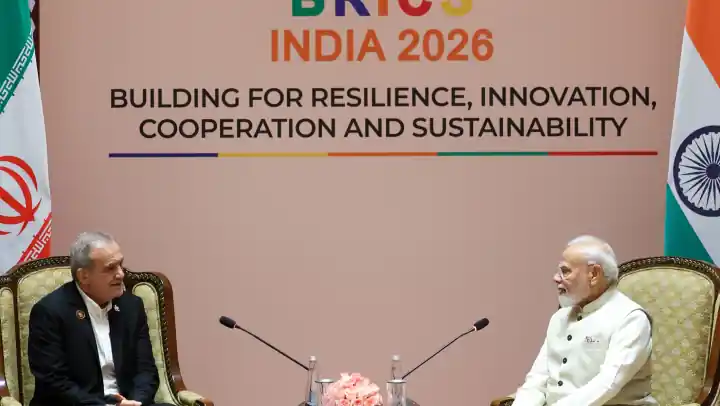
Pezeshkian's 11 September bilateral with Modi was their second in less than two weeks after the SCO summit in Bishkek. Hindustan Times said Modi urged dialogue and asked for freedom of navigation and seafarer safety. ThePrint reported that Iran had effectively closed the Strait of Hormuz for six months after US–Israeli strikes, which is why that sentence is not a slogan for India: a large share of its energy and fertiliser traffic still has to pass that waterway.
India's workaround has been partly Russian. AFP and Al Jazeera both noted New Delhi covering the energy shock with more Russian crude even while staying a Quad partner. That is the uncomfortable geometry: the same week India hosts Xi and Pezeshkian, it is also deeper in a Russia energy channel that Washington dislikes.
Chabahar is the other Iran file. News18 and ThePrint both treat the port as India's non-Pakistan route toward Afghanistan and Central Asia, and as a link toward the International North-South Transport Corridor. ThePrint said the project has been constrained since a US sanctions waiver lapsed. Do not report a new Chabahar breakthrough unless the Ministry of External Affairs publishes one. The meaning of the meeting is that the channel stayed open, not that the port was relaunched.
What this means for BRICS as a club — and for India as chair
News18's useful frame is a balancing act, not a bloc. On 11 September Modi met Putin and Pezeshkian. On 12 September he met Xi. In the same city he also had the UAE's Sheikh Khaled bin Mohamed bin Zayed and a Saudi delegation led by Foreign Minister Prince Faisal bin Farhan. Iran and those Gulf capitals were on opposite sides of the West Asia war that, AFP reported, stopped foreign ministers agreeing a joint statement in May.
The fact that leaders still adopted a unanimous New Delhi Declaration on 12 September is the chair's result. The text condemns unilateral coercive measures, talks about shipping and civilians, and stays careful on naming every party to every war. That is what a Russia–China–Iran presence plus Gulf members can still produce: lowest-common-denominator language, not a Tehran–Moscow–Beijing veto over the Gulf.
Payments are the same story. CNBC reported India steering the group toward national-currency settlement and cheaper cross-border rails rather than a political “kill the dollar” campaign. The declaration's Payment Task Force language is “continue the work,” no one-size-fits-all. Anyone reading “Russia, China, and Iran met, therefore a BRICS currency launched” is inventing a product.
What it does not mean
It does not mean BRICS is now an anti-NATO alliance. Brazil, India, South Africa, the UAE, and Egypt did not sign up for that. It does not mean India has chosen a China-led caucus; the Modi–Xi file is still border peace and a trade deficit. It does not mean Iran now writes the West Asia paragraph alone. It does not mean a new security guarantee for any of the three.
It does mean the 2026 chairship week made the grouping's hardest political geometry visible: sanctioned energy states, a cautious India–China thaw, and a Gulf–Iran split, all under one consensus rule. That is why the three arrivals mattered. The latest summit update is what they could still agree. This page is what their being there signals.
Brief the summit from the source documents
People compiling a one-pager or deck from the New Delhi Declaration use How to generate a PowerPoint. People grounding a chat in the PDF use How to chat with a PDF. New accounts start at app.ashna.ai/signup.
Frequently asked questions
- Did Russia, China, and Iran form a new alliance at BRICS 2026?
- No published text says that. Putin, Xi, and Pezeshkian were in New Delhi for the 18th BRICS Summit and sat in the same plenary. Each held a bilateral with Prime Minister Narendra Modi. That is presence and optics. It is not a Russia–China–Iran treaty and not a BRICS military pact.
- Why were Putin, Xi, and Pezeshkian the point of attraction?
- They are the three leaders whose wars, sanctions, and border files could have broken consensus. Putin arrived first as India's closest major-power defence and energy partner under Western pressure. Xi's visit was his first to India since 2019. Pezeshkian's was the first Iranian presidential visit to India in eight years, during a West Asia war that had already split BRICS foreign ministers in May.
- What did Modi and Pezeshkian discuss?
- On 11 September they reviewed West Asia and bilateral ties. Indian readouts stressed dialogue, freedom of navigation and commerce, and the safety of seafarers. It was their second meeting in less than two weeks after Bishkek on 31 August, and Pezeshkian's first visit to India as president.
- What does this mean for energy and the dollar?
- India has covered part of the West Asia energy shock by buying more Russian crude. Iran has pushed local-currency settlement and more diverse payment routes; CNBC and summit previews treat that as a sanctions-resilience file, not a launched BRICS currency. India has steered the grouping toward cheaper national-currency settlement rather than a political de-dollarization crusade.
- Does this isolate the Gulf members of BRICS?
- That was the chair's risk. The UAE and Saudi Arabia are in the same 11-member club as Iran. Foreign ministers failed to agree a joint statement in May because those files split. Leaders still adopted a unanimous New Delhi Declaration on 12 September. The Gulf delegations remained in the room. Treat that as managed coexistence, not a new Tehran–Moscow–Beijing caucus that wrote the text.
Tags
Related
Try this in AshnaAI. Create a free account.
Found this article helpful? Share it with your network.