
What is the cheapest coding AI that still holds quality?
The cheapest coding AI that still ships useful patches is GLM-5.3-Flash, not Claude Opus 5 or GPT-5.6 Sol. Flash list is about $0.15 input and $0.50 output per 1M tokens. Opus 5 is $5 / $25. Sol is $5 / $30. That is the cost-versus-quality gap searchers mean when they type “cheap coding model” or “Opus 5 alternative.”
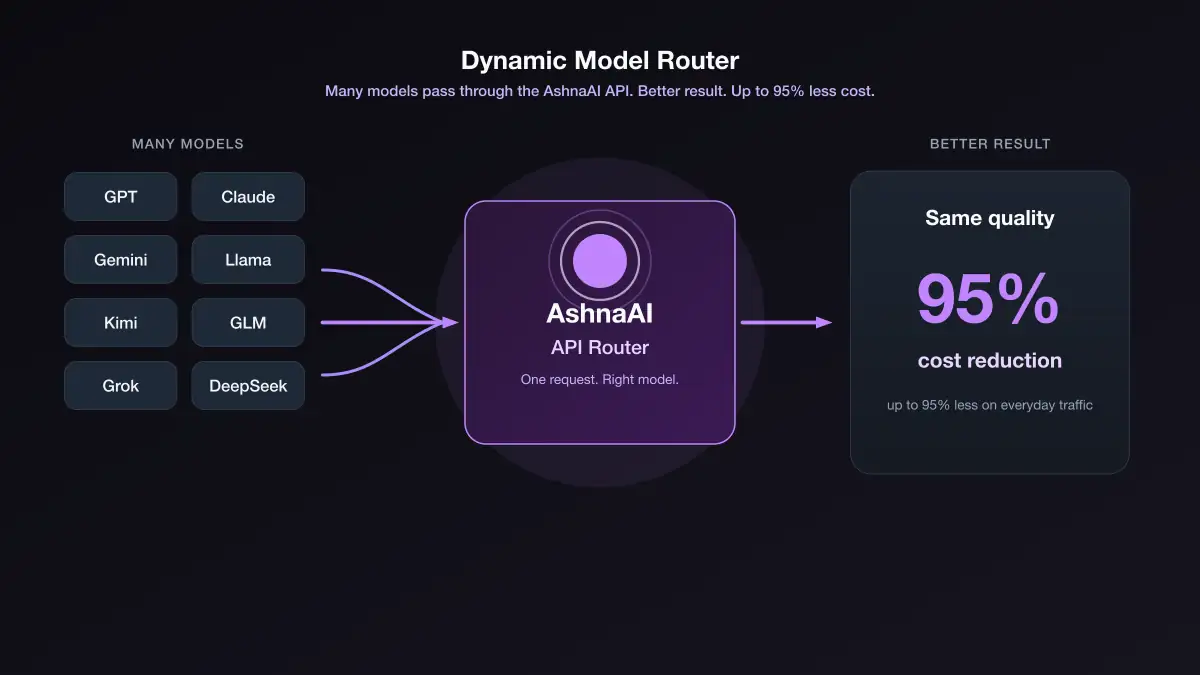
This is not “Flash is Opus 5.” It is “Flash is close enough on everyday volume that a flagship invoice is a habit, not a quality requirement.” Teams that want the same catalog from an app use the OpenAI-compatible API. Teams that want every turn classified automatically read Reduce LLM API cost by 95%.
Claude Opus 5 vs GPT-5.6 Sol vs cheap coding model: list rates
Developers compare logos. Finance compares tokens. A thousand Flash turns is ordinary usage. A thousand Sol or Opus turns is a line item. Credit plans still follow product billing. The ratio is why coding AI cost comparison pages exist.
| Model people search | Role | Input / 1M | Output / 1M | Vs cheapest coding AI |
|---|---|---|---|---|
| GLM-5.3-Flash | Cheap coding default | $0.15 | $0.50 | 1× |
| Claude Opus 5 | Anthropic flagship | $5.00 | $25.00 | ~33× / 50× |
| GPT-5.6 Sol | OpenAI flagship reserve | $5.00 | $30.00 | ~33× / 60× |
Z.ai published benchmark table
People also ask whether a cheap model “loses the bench.” Z.ai scored Flash against Claude Opus 4.8 and GPT-5.6 Terra, not against Opus 5 or Sol. Terminal Bench 2.1 is 84.3 vs 85.0 vs Opus 4.8. DeepSWE v1.1 is 63.4 vs 58.0. Terra leads some coding cells and still sits far above Flash on price. Later flagships can win hard jobs. They still lose the cost-versus-quality search.
The table below is the competitive scoreboard from Z.ai’s 26 August 2026 launch post.
| Benchmark | GLM-5.3-Flash | GLM-5.2 | DeepSeek-V4-Vision-Exp | Opus 4.8 | GPT-5.6 Terra | Gemini 3.7 Flash | |
|---|---|---|---|---|---|---|---|
| Coding | Coding | ||||||
| Terminal Bench 2.1 | 84.3 | 81.0 | 83.9 | 85.0 | 87.4 | 85.8 | |
| DeepSWE v1.1 | 63.4 | 46.2 | 59.3 | 58.0 | 69.6 | 65.3 | |
| NL2Repo | 56.3 | 48.9 | 57.7 | 69.7 | - | - | |
| Agentic | Agentic | ||||||
| Toolathlon Verified | 78.4 | 59.9 | 75.9 | 76.2 | 74.9 | - | |
| AutomationBench v1.0.6 | 48.8 | 26.2 | 38.8 | 41.0 | 37.2 | 52.3 | |
| Agents' Last Exam | 26.3 | 20.4 | 27.3 | 27.0 | 28.0 | - | |
| HLE w/ Tools | 55.3 | 54.7 | 55.1 | 57.9 | - | - | |
| GDPval-AA v2 | 1773 | 1504 | 1675 | 1582 | 1571 | 1527 | |
| Vision | Vision | ||||||
| OfficeQA Pro | 62.4 | - | 57.9 | 48.9 | - | - | |
| CharXiv Reasoning w/ Tools | 89.4 | - | 80.4 | 89.9 | 88.0 | 88.7 | |
| Chartography w/ Tools | 78.0 | - | 64.3 | 75.0 | 68.0 | 65.0 | |
| BabyVision | 53.4 | - | 35.1 | 46.8 | 61.6 | 70.9 | |
| MVbench | 77.8 | - | 69.4 | 67.1 | 75.0 | 82.2 | |
| MMVU | 80.5 | - | 72.7 | 67.4 | 75.8 | 82.3 | |
Why developers are leaving flagship pins
Agent coding multiplies tokens: retries, tool calls, screenshots, CI-style loops. Pinning Opus 5 or Sol “just in case” taxes every one of those turns. The quality buyers actually need on most turns—a passing test, a component, a UI clone—is already on the cheap coding row.
Leave the flagship for a customer-required vendor, or after Flash already failed. Pair pages: GLM-5.3-Flash vs Claude Opus 5 and vs GPT-5.6 Sol. The mid GPT step is Terra. How to pin: Pin GLM-5.3-Flash for cost-effective coding.
Try GLM-5.3-Flash now
Someone trying Flash inside the product opens GLM-5.3-Flash in AshnaAI chat. That URL pins catalog id glm-5.3-flash, so the first message already runs on Zhipu’s GLM-5.3-Flash. New accounts start at app.ashna.ai/signup. This is the pin people open when they searched for a cheap coding AI and do not want to start on a $5 / $25–$30 row.
Teams who want the same model from their own product use the OpenAI-compatible AshnaAI API. They create a key in Account → API, then POST chat completions with model set to glm-5.3-flash. The same model field works for every catalog row. Walkthrough: How to call any catalog model through the API. Reference: list models and chat completions.
Compared catalog list rates for glm-5.3-flash and gpt-5.6-sol with Anthropic’s public Opus 5 list and Z.ai’s 26 Aug 2026 Flash scoreboard (Opus 4.8 and GPT-5.6 Terra columns).
Topics
Related
- AshnaAI for Work
- AshnaAI vs ChatGPT
- AshnaAI vs Claude
- Large Language Model (LLM)
- Foundation Model
- pin glm 5 3 flash for coding
- glm 5 3 flash vs gpt 5 6 terra
- glm 5 3 flash vs gpt 5 6 sol
- glm 5 3 flash vs claude fable 5
- glm 5 3 flash vs claude opus 5
- glm 5 3 flash vs kimi k3
- how to call any catalog model through the api
- how to use the ashna ai api in vs code
- how to use the ashna ai api in claude code
- how to use the ashna ai api in cursor
- how to use the ashna ai api in openclaw cline and codex
- reduce llm api cost 95 percent
- how the dynamic model router cuts ai cost
- how to use ashna x1 instead of picking models yourself
- deepseek v4 1 flash launch benchmarks
- ashna x1 task aware model routing
Try this in AshnaAI. Create a free account.
Found this article insightful?
Share it with fellow builders, founders, and AI practitioners.