What OpenAI actually posted
On 28 August 2026 OpenAI published Our decision on Cursor following its acquisition by SpaceX. The note says SpaceX was notified that OpenAI intends to wind down the contract providing OpenAI models to Cursor, with a proposed shutoff date of 12 November 2026. OpenAI says that date is the maximum notice the contract allows, so developers keep current access as long as the agreement permits.
The same post says OpenAI will not provide future models to Cursor, and it names the upcoming model Astra in that sentence. Existing models are not described as going dark on 28 August. Reuters carried the notice the same day and reported that Anthropic co-founder Tom Brown said Anthropic planned to increase compute for Claude models in Cursor. That is a wire paraphrase of a social post, not an Anthropic newsroom PDF.
The mechanism is a change-of-control clause
Cursor’s parent, Anysphere, was acquired by SpaceX. Cursor’s own 14 August 2026 note said the acquisition had closed. OpenAI says large partners typically sit on custom contracts for terms-of-service compliance and safety at scale, and that the Cursor agreement gave OpenAI a limited window to cancel after a change of control.
That is a commercial exit, not a global outage of api.openai.com. First-party OpenAI routing inside Cursor is what OpenAI says it is winding down. Cursor co-founder Michael Truell, now a SpaceX executive, told Reuters the company is speaking with OpenAI and that OpenAI models serve about 5 percent of Cursor user traffic. Treat the 5 percent figure as Truell-attributed, not as an audited metric.
How AshnaAI is different—and better
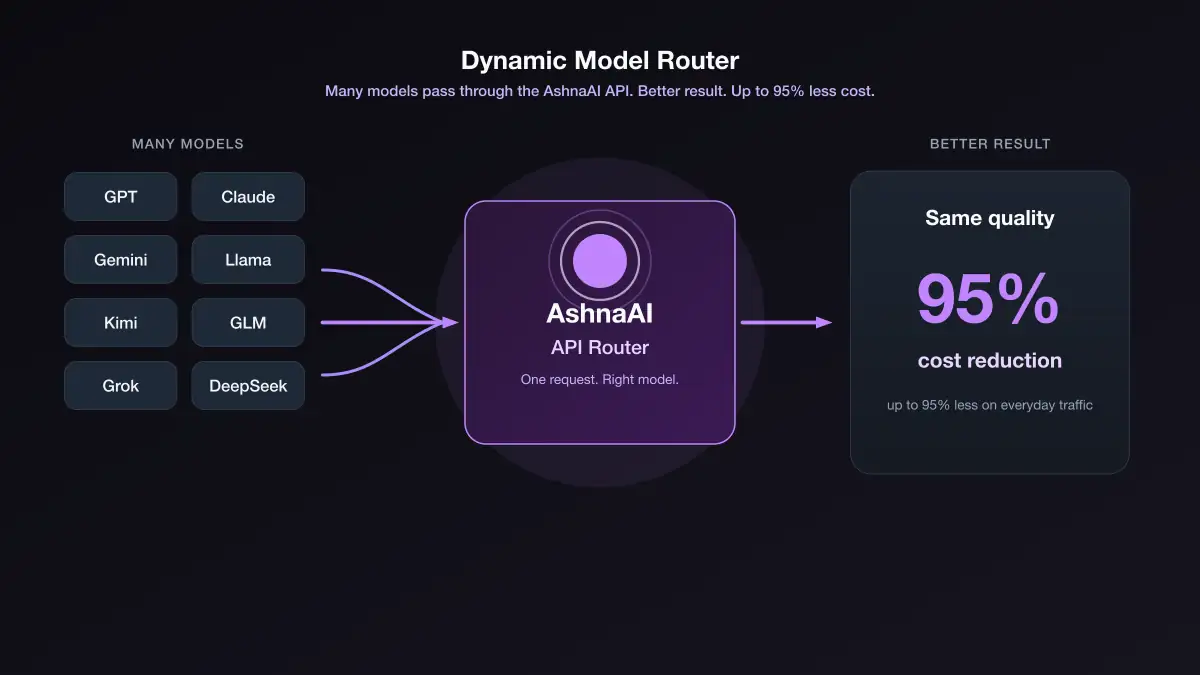
The market default after a cutoff is “pick a new IDE” or “wait on the lab.” That still leaves model supply inside someone else’s contract. AshnaAI is different because the catalog is the buyer’s: pin GPT, Claude, Gemini, GLM-5.3-Flash, or Ashna-X1. Switching a coding job from a GPT pin to Flash is a catalog change, not a new vendor onboarding. It is not a Cursor fork. People who need an editor keep an editor.
It is better because a change-of-control clause on one IDE cannot strand agents, files, or product code. The same ids run through the OpenAI-compatible API. Volume coding can pin GLM-5.3-Flash. Mixed work stays on Ashna-X1. Research: Ashna-X1 and task-aware model routing.
Value to the enterprise—then the links
Continuity when one lab exits an IDE deal. Cost control when everyday turns leave a flagship. Breadth when the next job is not a patch: AI PowerPoint generator, Tally automation, design and video, classroom notes, API walkthrough. API keys: Account → API. Compare: AshnaAI vs Claude.
Try a multi-model catalog now
Teams that want a coding pin that is not one lab’s exclusive supply open GLM-5.3-Flash in AshnaAI chat. Mixed work stays on Ashna-X1. New accounts start at app.ashna.ai/signup.
Enterprises that need the same catalog from their own products create a key in Account → API and follow How to call any catalog model through the API. Docs: AshnaAI API.
Sourced to OpenAI’s 28 August 2026 note and Reuters’ same-day pickup. Does not claim AshnaAI is a Cursor IDE replacement. The product claim is a multi-model catalog plus an OpenAI-compatible API.
Topics
Related
- AshnaAI for Work
- AshnaAI vs ChatGPT
- AshnaAI vs Claude
- Large Language Model (LLM)
- Foundation Model
- gpt 6 astra launch benchmarks
- deepseek v4 1 flash launch benchmarks
- how to use ashna x1 instead of picking models yourself
- how to call any catalog model through the api
- pin glm 5 3 flash for coding
- llm routing match tasks to models
- claude code restrictions microsoft uber
- cheapest multi model ai api
- ashna x1 task aware model routing
Try this in AshnaAI. Create a free account.
Found this article insightful?
Share it with fellow builders, founders, and AI practitioners.